NH #796: Utah Nuclear Madness: Out-of-State RadWaste + New Small Reactors + AI Data Centers?!? – Carmen Valdez of HEAL Utah

NH #796: Utah Nuclear Madness: Out-of-State RadWaste + New Small Reactors + AI Data Centers?!? – Carmen Valdez of HEAL Utah
Transcript
Episode transcript
Nuclear Hotseat #796 - Sept. 29, 2026 Utah’s Nuclear Madness:
Carmen Valdez of HEAL Utah
Libbe HaLevy: [00:00:00] Nuclear smoke and mirrors. Nuke boosters have been touting and spouting about how a sudden renaissance in their business using such benign PR focus group terms for this nuclear invasion of our communities as nuclear hub or nuclear campus, like they're setting up a school where neutrons scamper across the quad.
Or that big honking red flag SMRs, small modular reactors, which should be referred to as small modular nuclear reactors. These are all languaging tricks to make the uninformed, which is almost everyone, to buy into their claims of being the answer to all our energy needs. Safe, they shout. No risks, no dangers.
But then you hear from someone who has been holding the line against nukes for most of her life, who has got a lot to say about all of these. But when it comes to the lies about [00:01:00] the not yet existent small modular nuclear reactors, she smacks the truth out of the park when she simply asks about those cute little Lego adjacent modular nuclear reactors.
When has one been built? When has one been built to criticality? When has one run at a commercial scale? A small modular test reactor puts off some gigawatts of energy, maybe megawatts of energy. But to power a town or a data center, that is a lot of energy that needs to be consistently available. And we don't know that these are gonna work to the scale that they need them.
So we're putting the cart before the horse before the road's even been designated. And communities are calling it out. They're saying, "Why are you approving something that hasn't even been proven yet?"
Good question, and there are so many more. So when Carmen Valdez, seven-year veteran of HEAL Utah and their current [00:02:00] radioactive and toxic program manager, gives us the lowdown on Utah's legacy radioactive issues and the past, present, and future threats to our health that they pose, you find out yet another location for that awful, deadly, dangerous seat that we all share.
Numnutz of the Week Theme: Nuclear Hotseat. What are those people thinking? Nuclear Hotseat. What have those boys been drinking? Nuclear Hotseat. The corium is sinking. Our time to act is shrinking, but our activists are linking.
Nuclear Hotseat. It's da bomb
Libbe HaLevy: Welcome to Nuclear Hotseat, the weekly international news magazine keeping you up to date on all things nuclear from a different [00:03:00] perspective. We're a show for people who know nothing about nuclear who wanna know something, and people who know something about nuclear who would like to know just a little bit more.
My name is Libbe HaLevy. I'm the producer and host, as well as a survivor of the nuclear accident at Three Mile Island from just one mile away, so I know what can happen when those nuclear so-called experts get it wrong. This week, we talk with Carmen Valdez. She's a fifth-generation Utahn who currently serves as radioactive and toxic program manager for HEAL Utah.
It's a fascinating discussion of an enormous range of nuclear issues in a state that has pretty much been flying under the radar when it comes to national nuclear awareness. We will also have nuclear news from around the world, numbnuts of the week for outstanding nuclear boneheadedness, and lots more honest and verifiable nuclear [00:04:00] information, all of it coming up in just a few moments.
Today is Tuesday, September twenty-nine, twenty twenty-six, and here is this week's nuclear news from a different perspective. Following up on a story from last week, the incident at Palisades Nuclear Reactor in Michigan, which was taken offline in twenty twenty-two and closed down but is now purportedly being brought back and restarted from its zombie status, may not even slow down the forward progress that owner Holtec is pushing for.
On August thirtieth, as new fuel was being lowered into the reactor, one of the fuel assemblies tipped over, causing resumption to be placed on hold while Holtec assessed the situation. While everyone is emphasizing that only one fuel assembly was impacted, that fuel assembly includes two hundred and sixteen fuel rods containing radioactive [00:05:00] uranium dioxide, the actual nuclear reactor fuel.
Yet only two days after the incident, on September second, the NRC said the plant was moving closer to restart. And despite the Palisades mishap, Holtec is projecting optimism. Quote, "We remain focused on returning Palisades to safe and reliable operation once all restart work is complete." They even point to the attempted restart of the Three Mile Island Nuclear Reactor in Middletown, Pennsylvania, as reinforcement for their restart goals, as though two wrongs make a right.
And of course, there is no way to assess the long-range health and safety of the workers who may have been involved in this incident. Now comes word that the NRC has approved construction for the nation's first commercial small modular nuclear reactor. This at the Clinch River site in Roane County in Tennessee.
Meanwhile, [00:06:00] in Canada, despite the fact that in 2018 Canada published a strategic plan, a roadmap to develop small modular nuclear reactors across the country, with the first one predicted to be operational by 2026, it's not about to happen. Canadian Nuclear Laboratories, a major mover behind the push for small modular nuclear reactors since 2016, reported that the companies promoting 10 small modular nuclear reactor designs in Canada had either left the country, lost their proponents, filed for bankruptcy protection, or failed to secure private sector backing for their projects.
So in effect, SMRs are dead in Canada. We'll wait to see what impact this has or has not on the United States. And if it's going to have any impact, it better be soon, because here's this week's.
Numnutz of the Week Theme: Nuclear Hotseat, Nuclear Hotseat, Nuclear Hotseat. Nothin' [00:07:00] nuts out a week.
Libbe HaLevy: Members of the Senate Committee on the Environment and Public Works are considering a 50 billion, with a B, dollar federal plan that would fund three future, what they are calling nuclear innovation campuses.
Boy, doesn't that sound great? And they're designed to attract heavy manufacturing industries with, put this in quotes, "abundant energy," while also housing radioactive waste. Well, they're housing the waste because they got no place else to put it. Each of these three regional hubs, another little benign languaging trick that they use, will each consist of data centers, small modular nuclear reactors, and commercial nuclear fuel recycling facilities.
And if you are in West Virginia, Tennessee, Louisiana, Utah, Oklahoma, or Idaho, you are on the front lines because your states have all said, "Hey, baby. Mm, yum. Bring it [00:08:00] on." The program under development would concentrate everything in states that have agreed to store the waste in exchange for the opportunity to host the large scale manufacturing plants expected to cluster near these regional energy hubs, which would better be called regional future contamination superfund sites.
Going to link to this article because there's so much here to unpack that is wrong with them even thinking, let alone debating instituting this plan. And that's why, Senate Committee on the Environment and Public Works, you are this week's.
Numnutz of the Week Theme: Nuclear Hotseat. Nothin' nuts out a week.
Libbe HaLevy: Here's this week's featured interview Healthy Environment Alliance of Utah, or HEAL Utah as it's known, has been a grassroots advocacy organization based in Utah for over 26 years.
Carmen Valdez is HEAL's radioactive [00:09:00] and toxic program manager, and she focuses on radioactive legacy issues that we are dealing with in the present and future threats to our health. HEAL is working on a wide range of issues for the state, but right now it is specifically fighting against a federal nuclear hub near the Great Salt Lake and within the watershed, while at the same time fighting against proposed nuclear reactor sites, mostly with new and commercially untested reactors throughout the state.
To learn more about these issues and a whole lot more, I spoke with Carmen Valdez on September 25th, 2026. Carmen Valdez, it's great to have you here with us today on Nuclear Hotseat.
Libbe HaLevy: Thanks so much, Libby. We're so excited to be here.
Libbe HaLevy: Let's start out with a real basic question. What is HEAL Utah?
Libbe HaLevy: HEAL Utah stands for the Healthy Environment Alliance of Utah.
We are a grassroots advocacy [00:10:00] organization that's been based in Utah for over 26 years.
Libbe HaLevy: How did HEAL Utah start, and what is its focus today?
Libbe HaLevy: HEAL started as a group of concerned families fighting against the Tooele Army Depot during incineration of chemical weapons that was being released into the community, who stepped up to start as the Families Against Incinerator Risk, or FAIR.
And now we have grown into a community of over 25,000 supporters throughout the entire state of Utah, and we continue to protect our communities from air pollution. We work on building a just and equitable energy future. And holding strong to our roots, we are still protecting communities from radioactive and toxic threats.
Libbe HaLevy: That group of people got together 26 years ago. How has HEAL Utah's work changed over the past 26 years?
Libbe HaLevy: HEAL's work has continued to be very grassroots-focused. So [00:11:00] we hear from our community members, our families, our individuals who are concerned about how their health is being impacted by environmental threats.
And we take that, and we go to the Utah State Legislature, where we lobby, and we teach people how to lobby. Our community lobby training program is one of our most favorite times, when we bring people up to the Capitol to respectfully harass our legislators when necessary. And we are also an education organization, where we take the science lingo mumbo jumbo that can be really hard to access as well as understand, and make it understandable for the everyday person to say, "This impacts your health in this way.
Here is how you can protect yourself, and join us as we try to make our protection and, and standards better." So we are, we are boots on the ground. We are talking with communities. We are getting emails and phone calls and meetings from different [00:12:00] community members. We go to council meetings. We go to committee hearings and legislative hearings, and we give public comment.
We host webinars and information sessions in person, giving communities the resources they need to protect their health for the future.
Libbe HaLevy: In terms of education, the show last week, Nuclear Hotseat number 795, included an extensive interview with Mary Olson and Cindy Folkers on their new program, Atoms and Eve.
And I was wondering if you're familiar with that, and if that is something you're planning to incorporate in what you share with your communities?
Carmen Valdez: Oh, absolutely. Mary Olson and Cindy Folkers have been incredible mentors for me personally, but also just incredible advocates and researchers and scientists.
HEAL has been using their information as it relates to radiation impacts on our families to be able to get that information out to our everyday [00:13:00] citizens. So we are excited to share their information. We also had both of them as one of our first experts on one of our webinars about the radiation impacts on families, and we were able to really dive deep into how radiation impacts different family members differently, whether male, female, children, adolescents, adults.
And that is something that is very much apparent in Utah following the Radiation Exposure Compensation Act as well.
Libbe HaLevy: You are HEAL's radioactive and toxic program manager What is your background, and what brought you to this position? And then we'll talk about exactly what it entails.
Libbe HaLevy: First and foremost, I am born and raised in Utah.
I am also the granddaughter of a Downwinder, which I didn't find out until I started this work. To get my boots on the ground going, I started with a bachelor's in political science through the University of Utah. I interned through the Utah State Legislature, [00:14:00] where I got to learn the back end of how bills become laws and how fast 45 days can really move.
The 45 days referring to? The 45 days of a legislative session in Utah, and all the other information I've gained from that. I then pursued a master's in international affairs and global enterprise through the University of Utah. I focused on mainly human rights, and was able to niche focus on uranium mining and the problematic industry that exists in the Congo and in Africa.
And I wanted to use that information to take my skills to become a policy advocate to protect my community at home. Think global, act local, right? So here I am following my master's degree. I started as a grassroots organizer, because I am great at engaging with our public and getting people the information they need, and hearing from them, and [00:15:00] using those skills to catapult me into policy work, and now as a program manager.
I have taken many nuclear courses and radiation exposure courses over the last couple of years. I spend way too much time reading into everything, and reviewing over documents, and hearings, and meeting minutes, and continue to expand my education when it comes to this specific field of radioactive and toxic threats.
Libbe HaLevy: How long have you been with HEAL Utah, and what are some of the actions that you have been involved with?
Carmen Valdez: I have been with HEAL Utah for about seven years now. Oh my goodness, seven years. So I've been able to grow from grassroots to policy to senior policy to now program manager. The projects that I've been most fulfilled by and excited by has been working to expand and then eventually reauthorize the Radiation Exposure Compensation Act, and we were able to [00:16:00] get that reauthorized last July, as well as expanded to include the entire state of Utah, which took so much time and meetings.
I continue to do lobbying for HEAL Utah and supporting our community lobby sessions, so giving people the information they need to lobby for themselves and their community so it's not just HEAL up there. And then we are working on radiation education and knowledge and where to go to find resources for that.
I continue to work on uranium mill issues and uranium mining in the state of Utah. Utah has the only operating uranium mill in the country, and we stand with the Ute Mountain Ute White Mesa Community, and have been attending their protest annually. I think I've only missed one year in the last seven, and I still regret it.
And we continue to try to have better standards for that mill and limit the expansion of the mill itself, [00:17:00] and the expansion of uranium mining, which we are seeing come forward. And then just in the last year, oh man, we have been watching all things nuclear. So not only uranium mining, milling front end, we are watching proposed testing of small modular reactors throughout the state.
We are watching the potential of our state becoming the dumping ground for high-level radioactive waste from around the country. We continue to watch low-level waste coming into our state. Most recently it was approved by the Northwest Interstate Compact for Energy Solutions to bring in low-level radioactive waste from Canada, and they are now in the middle of their process of getting approval from the Nuclear Regulatory Commission.
We're seeing the federal nuclear campus being proposed, and then nuclear sites throughout the state, which could be detrimental for our state in the future.
Libbe HaLevy: Let's drill down a little bit on this. You [00:18:00] mentioned RECA, the Radiation Exposure Compensation Act. What has been Utah's history with it, and why is it important for this to have been expanded and to include the entire state?
Carmen Valdez: RECA exists because of Utahns. Essentially, communities in St. George and Southern Utah started noticing a trend of their family members, their community members, their neighbors getting sick with cancers and illnesses to the point that they were seeing entire neighborhoods having at least one person in a household, um, developing cancers and illnesses.
And they started asking questions about why there was such a cluster of these cancers and diseases in this community, and they were able to trace it back to the radiation exposure from nuclear weapons testing during the Cold War era at the Nevada test site And they knew this was a thing. Many of them would watch the bombs or the fallout come over, but they were [00:19:00] told over and over again that there was nothing to worry about.
There was no harm to their health, it wouldn't be an issue. But these community members, these amazing advocates, stood up, continued to ask questions, and eventually filed a lawsuit against the, uh, US government for essentially harming them and causing severe health issues. Based on that, they were able to connect with Utah Senator Orrin Hatch at the time, who then decided to create the Radiation Exposure Compensation Act, which is a presumption bill instead of having to rely on a lawsuit, right?
We see those lawsuits come through. That if you were in a specific area during a specific time and developed these specific cancers, you were to be eligible for compensation. This included on-site workers, so those military workers or those janitors who were working at the Nevada test site. It included our uranium miners, millers, [00:20:00] transporters, all of those involved who also developed cancers, as well as what eventually became known as Downwinders, who are those who lived downwind of the Nevada test site.
So thanks to decades of their work, and then continuous work after the program was approved in 1990, we were able to gather more information and data to show that fallout didn't stop halfway through the state where the Downwinders were defined. It eventually just cut the state in half, and it was just those communities.
But so many people throughout our state, family members, friends, neighbors, were also developing cancers, and Utah has one of the highest cancer rates, even though we are healthy. We don't smoke, we don't drink, we're outdoors, we're active. So what we were able to show is through maps and studies like the Princeton study of the '98 atmospheric weapons test, that the fallout didn't stop at those lines.
In fact, that fallout blanketed Utah, which was so [00:21:00] important to get the bill expanded to cover all of Utah because there were people who were not covered before who deserved to be compensated by this program because they, too, were living with cancers, and losing family members and friends, and dealing with those effects.
So that study has been able to show that a lot of communities, essentially the entire United States, has been covered in radioactive fallout. And by starting with this expansion in Utah to show how many people deserved to be covered is still a small fragment of those who deserve to be compensated. So we're still proud of the work, and we are so grateful, and we are now seeing so many community members in my family, in my husband's family, in everyone's family, where I tell them about the program, and they're like, "Wait a minute, my grandma was a Downwinder.
My grandpa was a Downwinder. Both grandparents are Downwinders," or, "My mom was." And so now we're helping people get the compensation and, frankly, the acknowledgement they [00:22:00] deserve that they made a sacrifice they didn't have a choice in making in the name of national security
Libbe HaLevy: You also briefly mentioned that there are plans afoot to make Utah the national dumping ground for radioactive waste.
Where would that be coming from? How is that being manipulated, and what's the current status?
Carmen Valdez: We're all kind of watching the Federal Nuclear Innovation Lifecycle Campus, whatever the name may be, that the Department of Energy put out to get responses from states who would be willing to host one of these campuses.
Um-
Libbe HaLevy: Sound, sounds like they're walking around with canapes
Carmen Valdez: on a tray. Y- yes, yes. Yeah, they're like, "Who's willing to take this?" And Utah is one of those states that submitted a response, one of five states. And in reviewing that document, essentially our Office of Energy Development and our governor have said that Utah [00:23:00] will do everything in the nuclear industry, from uranium mining, milling, processing, enrichment, to housing nuclear energy facilities, to storing the waste, and looking at the potential of creating a repository for national waste.
So this is essentially shifting a Yucca Mountain into Utah or one of these proposed sites. What we have seen is that they were able to get some resolutions passed from Tooele County commissioners, three days before the announcement, mind you, this resolution was passed.
Libbe HaLevy: Wait a minute, the resolution was passed before it was announced?
Libbe HaLevy: Three days before it was announced, saying that Tooele County was in favor.
Libbe HaLevy: How is that even possible? Shouldn't something be announced and then go up for a decision or debate or vote on it?
Libbe HaLevy: That has been our question for the last year. Yes, and the fact that if you were [00:24:00] to look at the agenda, it says Energy Campus, not Nuclear Energy Campus.
So Tooele residents came to us and were like, "What do you mean? What is this? We're just being told it's a power reactor. We don't know what this means." And we say, "Yeah, same." What we're seeing is that Tooele County commissioners have okayed a nuclear campus that will be essentially across the only highway out there, and then up into and in the watershed of the drying Great Salt Lake.
They also said that they did a study of Tooele County residents, and we were like, "Okay, good for the state, doing a study to see who's in favor." We found out through that response only 200 residents of a county of 80,000 to 100,000, as per the last census- Is not enough of a data set to show who is in favor of a nuclear campus in their backyard.
200 people is not a data set. And then [00:25:00] shortly after, we started hearing from community members calling us and saying, "What's happening? What's being proposed there? I heard it's just nuclear energy." And we have to tell them, no, they're wanting to bring in high level radioactive waste to either reprocess, which doesn't exist in the country, mind you, or to be a permanent disposal for high level radioactive waste.
So this is all being proposed in Tooele County, where an existing low level radioactive waste site exists, and then it'll encompass that and grow into state lands and public lands just north of the highway into what could be a very radioactive site for our state.
Libbe HaLevy: So this would be turning Tooele County into a nuclear hub.
That's one of the terms that they like to throw on when they do use the other N-word, nuclear. They like taking it out whenever possible, so it's not a big red flashing sign in people's faces. But this is about [00:26:00] creating an interconnect of manufacturing and storage and transport and all the rest of it in one place, making it a hub, which sounds positive, when really what it's about is having a concentrated area of radioactive waste that would include not only uranium, but plutonium from the used fuel rods, and that won't go flat, that won't go not dangerous for a quarter of a million years.
Carmen Valdez: Correct.
Libbe HaLevy: Well, isn't that a lot of fun?
Carmen Valdez: Yeah, I pulled up here on Utah's response for the Nuclear Lifecycle Innovation Campus or Hub. Here's just a quick list of all that Utah has offered up to the federal government. Nuclear fuel reprocessing, disposal of waste streams, fuel fabrication for fresh and reprocessed materials, [00:27:00] conversion for fresh and reprocessed materials, uranium enrichment for fresh and reprocessed materials, reconversion of certain fuels, data center construction and operations, advanced reactors, uranium mining and milling, isotope production, advanced manufacturing, proliferation resistance, transportation networks, decommissioning site remediation.
And that's all on paper of what Utah's offering up to the federal government in terms of nuclear waste.
Libbe HaLevy: It's almost like they are planning to create the equivalent, if not exceed, what's been happening in Piketon, Portsmouth in Ohio, where they're taking a terribly contaminated radioactive and other materials polluted area and turning it into a nuclear hub for the state as though that's a good thing, without first remediating the ground that's underneath that's already radioactive.
So it sounds like there's an attempt or a vision to [00:28:00] create something comparable while polluting an area that is not necessarily yet as bad as what's going on in Piketon, Portsmouth.
Carmen Valdez: Correct. Yes. Yeah, there is a low-level radioactive waste site encompassed within this nuclear hub that you can see, but they're proposing everything, and we're already hearing from some of our great allies in other states that our state is offering, like safe sound and offering decommissioning that we'll take that waste without having a place to put that waste, without having reprocessing, without talking to the community on if that's something that they want coming through their communities to then be reprocessed and shipped out again.
This is all something that is, uh, is being proposed, and we know there are radioactive contaminations in the area already, and they're just climbing on top of that, adding more to it, creating more risks for our communities. [00:29:00] And within a watershed, mind you, there are spots in this watershed that the water is only 10 feet below ground surface.
Safe disposal of certain materials, low level, mind you, of materials, is 30 feet below the surface. So if we have a water table coming up to 10 feet below, how are we gonna dispose of high-level radioactive waste in this watershed?
Libbe HaLevy: Without contaminating
Activist Shoutout: the water
Carmen Valdez: itself. Exactly. Exactly, yes.
Libbe HaLevy: We'll continue this interview with Carmen Valdez of HEAL Utah in just a moment.
But first, when it comes to nuclear power, nuclear weapons, radioactive waste, uranium mining, and radiation exposure, finding information you can trust is difficult. The nuclear industry has its public relations machine to twist the conversation. Government agencies have their talking points to cover their posteriors, and mainstream media too often gives these [00:30:00] stories only a passing glance or misses them altogether.
That's why Nuclear Hotseat is here. Every week, we bring you information, voices, and perspectives you're unlikely to hear anywhere else. We follow the stories, ask the questions, and do it independently, taking absolutely no money from the nuclear industry or its allies. But independence is expensive, and continuing depends on you.
Nuclear Hotseat is a nonprofit, and listener donations are what keep this program going. So if you value having an independent source of nuclear information, if this program has taught you something, alerted you to something important, or simply reassured you that you're not the only one paying attention, please help support it.
You can do so by going to nuclearhotseat.com and hitting the Donate button. Any amount you can [00:31:00] donate helps, and a monthly donation, even as little as $5 a month, helps give us the financial stability we need to keep showing up week after week. You can also donate through Zelle at info@nuclearhotseat.com.
Nuclear Hotseat is a 501[c]3 nonprofit, so your donation is tax-deductible to the extent allowed by law. Because independent information doesn't just appear, someone has to do the work and make sure that work can continue. So here's the deal: I'll continue to do the work, and you help make certain Nuclear Hotseat can keep doing it.
Please donate today at nuclearahotseat.com, and thank you for caring enough to keep this independent voice alive. Now back to this week's featured interview with Carmen Valdez of HEAL Utah.
Libbe HaLevy: It's truly outrageous, [00:32:00] and from my catbird seat here at Nuclear Hotseat, we're coming up on episode number 800,
Utah has been flying under the radar.
And if I had not heard you speak a few weeks ago at the Samuel Lawrence Foundation San Onofre symposium, I would not have been keyed into the fact that this is going on. So I'm glad to be able to bring this forward to the listeners. Now, another big issue as regards nuclear, and that is data centers.
They have been connected across the board with proposals for new small modular reactors. Again, they leave the other N-word out. It's not small modular nuclear reactors- ... except on this show. But they have been linked to each other. My feeling is that if you're against data centers, you've gotta be against small nukes too, because all it is is a setup for down the line saying, "Oh, we've got the nuke already.
We might as well run the data center." What has been the [00:33:00] connection between the two as it's been playing out in Utah?
Honestly, HEAL has seen that connection, but we've had to make that connection for our communities. There was a huge, rightfully so, backlash against the proposed 40,000 acre data center in Box Elder County, and I remember being on a sh- on one of our radio shows, and someone was like, "I'm so concerned about living next to a data center and my kids getting cancers."
And I let them finish, I'm like, "Okay, that is concerning, but you also need to be concerned about the nuclear reactors that are being proposed on the site, as well as throughout your state, because those are also going to be linked to cancers. The uranium fuel production, testing sites, all of this are gonna create radioactive waste that can cause cancers for your kids in the future."
What we're seeing is data centers, there's been a few that have said, "We're gonna power, but with nuclear reactors in the future. Don't worry, like, that's the plan." But our biggest concern [00:34:00] is that nuclear reactors, even these small modular nuclear reactors, are 10, 15, 20 years down the line, and data centers are trying to be built today, right?
They're, they're not gonna wait 10, 20 years for these nuclear reactors. So are they gonna power with existing energy infrastructure, diesel generators, natural gas? Or are they gonna wait for those nuclear reactors? Or are they gonna try to build them at the same time and push through reactors for testing in a way that is gonna be unsafe for the communities?
And then additionally, oh, Libby, we have heard that there is a proposed data center campus in central Utah that will also house small modular nuclear reactors. And not just one, we're talking 450 small modular nuclear reactors on one site to power a data center in central Utah.
Libbe HaLevy: But they haven't even come up with a design that's been approved, and a single one has not been built, [00:35:00] let alone tested for proof of concept.
Carmen Valdez: Correct, correct. We have had one in Utah that reached criticality for a couple hours, and then they shut it down. But they're proposing these huge, massive sites on public lands next door to communities. Like, they know where these sites are located, and they're proposing data centers with huge numbers of small modular nuclear reactors.
Talk about nuclear proliferation risks and what that means and how much waste is gonna be on site. How are you gonna get the materials? Like, 450 small reactors is insane. It is insane. And how are you going to ensure that each and every single one of those is safe, up to code, meeting standards every single day?
That is crazy amount of people who need to be there and be aware of the issues there. But this is just some of the proposed data center nuclear combos we've been seeing in the state of Utah.
Libbe HaLevy: [00:36:00] Utah came very close to being the first state to approve of the new unproven small modular nuclear reactors.
And there was a deal between UAMPS, which is your utility, with Nuscale, which at that point did have an approved reactor design, and they were on board, they'd signed off, they wanted six reactors. What happened to cancel that deal?
Libbe HaLevy: Frankly, economics. A trend we continue to see in all of these nuclear proposed energy plans is that the costs double within just a couple of years of these planning out.
So what happened is an original... And please check out our webinar, because there's a good detail and graph on this. But the original Nuscale proposal was, like, 9,000 plus for kilowatt hours when it first proposed, right? It was, like, 9,000-ish. By the time it canceled, it was [00:37:00] 21,000 per kilowatt hour. It doubled in cost.
So the UAMPS communities were like, "We are a small rural communities. We cannot afford to double our cost just to build the plant to then pass that off to our rate payers. That's not economically viable, and it's not safe for our residents either to increase their rates that much." And we've seen that with the Vogtle plant.
Community members were paying for a plant long before energy ever came online for them. So the Nuscale plant went downhill because communities were like, "We're not paying double the energy costs that we could for all these other energy options that we already have accessible," including the solar plants they've put in, the wind plants they've put in.
So the Nuscale plant was straight up economics and timeline, that it wasn't coming online fast enough, and it was gonna be twice the cost of anything else they were looking at
Libbe HaLevy: I believe there was an additional factor in that [00:38:00] when Nuscale crunched the numbers on what they were going to be making off of these small reactors, it was not enough.
They were not going to make enough. So they tinkered with the design, but didn't bother to go back to the Nuclear Regulatory Commission and say, "Gee, we tinkered with the design. How about giving us an approval on this?" They were just getting ready to barge right through, and the NRC did put the brakes on it, and that led to the other developments that you just talked about.
Carmen Valdez: Yes. And so now Utah has had one test small modular reactor, might be a micro reactor, through Valor Atomics, through the San Rafael Energy Lab, which receives state funding, mind you. And Valor Atomics is also the one proposing this data center small modular reactor campus that's going on. Libby, I don't know if you've looked into Valor Atomics, but this is a high school dropout, self-taught software engineer turned self-taught nuclear [00:39:00] engineer-led company, and- That's...
Libbe HaLevy: Excuse me, I have to laugh at the, at the level of, quote-unquote, "competence" you are expressing here
Libbe HaLevy: Yes, that is the founder of Valor Atomics. Pick up by your bootstraps. But for someone who has spent years in school, years researching this, I'm never gonna consider myself a nuclear physicist, a nuclear engineer, because I'm, I'm not.
I'm not trained on that. I didn't go to school through that. So those are the people we're seeing project and promise these small modular reactors to these communities and to the state, instead of really relying on nuclear engineers to develop these. And what you highlighted on most, right, these are all paper reactors.
They are theories, they are tests. And don't get me wrong, I am so excited about how innovative humans are, right? All our scientists and our engineers, they're continuing to try to develop better systems, right? They're not getting worse, hopefully. They're trying not to be worse than what ag- has already existed, which is [00:40:00] really, really exciting for all of us.
However, when has one been built? When has one been built to criticality? When has one run at a commercial scale, right? A small modular test reactor puts off some gigawatts of energy, maybe megawatts of energy. But to power a town or a data center, that is a lot of energy that needs to be consistently available, and we don't know that these are gonna work to the scale that they need them.
So we're putting the cart before the horse before the road's even been designated in a lot of these cases, and communities are calling it out. They're saying, "Why are you approving something that hasn't even been proven yet? We don't even know these reactors are gonna work in the way that you think they are, and they don't even have NRC approval."
Oh, it's left and right. It's smoke and mirrors all over.
Libbe HaLevy: They are so good at what I call the, "There, there, missy, don't worry your pretty little head about it," defense [00:41:00] of what they're doing because they're the experts and we are not. Whereas the activists such as yourself, in addition to the schooling you've gone through, there is the on-the-ground knowledge you have gained, that you have learned from others who have been working in nuclear, where maybe we don't have the alphabet soup after our name, but we've got the knowledge because we gained it the hard way because we had to, and we were motivated to, and we're not going to let it go.
What other aspects of this do you think it's important for Utahns, and those of us who don't live in Utah, to know about so that we can understand what is going on there?
Carmen Valdez: First, for listeners, be looking out for Utah. We have a really, really long history of the nuclear industry. Think about your entire Southwest communities, truly.
New Mexico, Arizona, Colorado Plateau, Utah, we are all where a lot of that uranium came from, Idaho included, Wyoming. And [00:42:00] we have that long history to the point that this is decades ago, right? The 1940s, 1950s, '60s, '70s, '80s, '90s, where there are abandoned uranium mines from the past industry that have never been cleaned up.
And these are, you know, places where as you're out exploring our beautiful nature like, "Wow, cool, let's go check this out." Not all of them are marked off as radioactive. We still have community members and uranium miners who cannot receive RECA compensation because of the lack of company information to prove that they worked for them, or to prove that they were in this place at that time.
Our soils are still radioactive. There is now studies showing that radiation can be passed intergenerationally, so that we mentioned Mary Olson, right? Sidney Dilbers. That if grandma was pregnant with your mom at a certain gestational period and was exposed to radiation, every single grandchild could be impacted [00:43:00] because of the ink development within the fetus, right?
They're also exposed to radiation. So all right, we're seeing the history of nuclear weapons in Utah, long lived, still with us today. To then restart uranium mining, milling to put proposed reactors throughout our state to transport high-level waste through our state to be dumped next to our Great Salt Lake, adding on top of all of the other exposures we already have, and essentially signing the medical records of, yeah, you're gonna get cancer at some point in your life because there are so many exposures and compounded exposures to this effect.
And then one thing that we haven't touched on, so we've been very much focusing on the nuclear energy data centers, all of that, is uranium mining and milling. So while this is all happening in Salt Lake and Central Utah, down south we have the only operating uranium mill in the country that has had Clean Air Act [00:44:00] violation, that the tribal nation living downwind is constantly concerned about when or if their water is gonna be contaminated by radiation.
Having to drive past that mill, having truckloads of uranium ore drive past them and through their community, 'cause there's only one road down there. And then with the recent announcement of the reduction of national monuments, Bears Ears and the Grand Staircase-Escalante, that was specifically for mining and specifically for uranium mining.
And we saw applications for mining sites for uranium days after, days after. And as soon as it became available, we saw even more applications come through. We also saw, I don't know, Libby, if you watched the CEO, uh, board chair of Energy Fuels, which runs the uranium mill down there. They were also being investigated by Congress for insider trading because they purchased [00:45:00] shares days before the Bears Ears-Grand Staircase-Escalante announcement So what we're seeing is a revival of an industry that is toxic to humans and who work in it, and hopefully there's better practices today than there was in the '60s.
But the threat remains that, one, if communities don't have job options and these are the only job options that are being offered, people need to survive. And so what risks are they and their families going to take in order to survive when needing funds to be able to survive in our system and economy?
And then additionally, what happens to the communities that these ore trucks have to drive through in order to deposit the ore, and then the yellowcake be shipped off to somewhere else, right? They're a huge threat of risk. I'm gonna take it even a step further. We have been watching our climate changing, and we know it's changing.
This past year we have seen [00:46:00] wildfires, wind events, flooding, all of the above at rates the entire country's never seen before, right? Last year when I was down in White Mesa, a tornado hit down in southeastern Utah. I've never heard of a tornado hitting in southeastern Utah. So when we're thinking about revamping all, and restarting all these industries- What happens when wildfires are taking over Bears Ears, burning hundreds of thousands of acres, which already happened this year?
What happens if there's a windstorm that blows material into communities that then lands on their food, lands on their bodies, gets into their systems? What happens to communities if a tornado comes through a uranium mill and picks up materials? We are not prepared for what's gonna happen when our climate is getting worse, and yet we're creating more radioactive sites along the way.
And what risks does that bring to our communities that live downwind, downstream of all those [00:47:00] materials?
Libbe HaLevy: When you talk about the spread of those kind of materials, here in Southern California near Los Angeles, there's the Santa Susana Field Lab, which had experimental reactors. There were no containment structures, and there were nuclear accidents there that were not reported and were only discovered by accident 20 years afterwards.
So the site is known to be contaminated and highly radioactive. Parents Against Santa Susana Field Lab and Melissa Bumstead have been doing a great job on that. But when, I think it was about three years ago, we had a fire that came through that land and re-aerosolized in the smoke some of the dust that was there.
Within hours of the fire breaking out, Southern California Edison was already saying, "You've got nothing to worry about, there's no radiation," blah, blah, blah. And they wouldn't do any follow-up on it. So the parents pooled their pennies, hired some experts, did a complete [00:48:00] citizen scientist collection of dust within a 10-mile radius, and sent it off for blind lab samples.
I mean, nothing was labeled as to where it was, and within that 10 miles they found, I forget the total number that they found. I want to say 17. I don't know if that's accurate. But I do know that a plutonium-containing radioactive particle from that fire was found 9.2 miles away in Sherman Oaks. So we know this happens.
The, "They're there, Missy," doesn't work when people bother to learn these things for themselves. And the cautionary tales that have already been learned the hard way in so many communities deserve to be made available and within the knowledge base of people in Utah, and anyplace else that wants to expand their nuclear footprint, their nuclear profile.
Because that's the only way we can stop them before they get a toehold and they move forward
Carmen Valdez: [00:49:00] Correct. Giving communities a choice, right? We want communities to be proud of what's in their community, and if that is something they're seeking, then they need to have all of the knowledge. What we're seeing in Utah instead is billboards saying, "Nuclear plants emit less radiation than bananas."
The old banana radiation.
Libbe HaLevy: Which is such a bananas idea.
Carmen Valdez: It is, especially when you're comparing potassium as a radionuclide to plutonium, uranium, all these other radionuclides. Like, we haven't seen a cancer caused by potassium yet, but we have seen cancers caused from all these other radionuclides. And communities deserve...
And you're right, communities know better. We know. We know when something's affecting our communities and making everyone sick. So we want our government to let us have that choice in what's going on, and provide health options for us, and to provide emergency preparedness for us, and to recognize that there is not any single way we can have 100% [00:50:00] safe, foolproof, no issue nuclear reactor, nuclear site.
It, it is impossible. Our expert on our webinar, Dr. Benjamin Sovacool, highlighted that, you know, based on statistics and based on that humans make mistakes and so do computers, we're likely to see a nuclear accident every 20 to 60 years. What happens if we add more of those, right? We're increasing the statistics of what can go wrong, and we want to make sure that if this is something we're pursuing, that, oh my goodness, we're not creating a new generation of downwinders, that we're not creating a new generation of uranium workers who die of lung cancer in their 50s.
People know these cause problems, and we also know there are better energy options available for us and they're faster, they're cheaper, they create less harms, and they can literally be deployed in years versus decades, and put less people at harm [00:51:00] for radioactive contamination.
Libbe HaLevy: As I've heard it said, if there is an energy spill at a solar plant, all you have is a sunny day.
Is there anything we haven't covered that you feel important to touch upon at this point?
Carmen Valdez: I think what is most important is for listeners, and hopefully one of our decision-makers are hearing this as well, is that we want to be part of this discussion. We want you to acknowledge that there are risks instead of saying, "There, there, missy.
Don't worry, we've solved this," saying, "We understand there's some risks. Here's what we're trying to do to protect your community." And make sure communities have a say. What we're seeing right now, and I'm sure you're seeing this with all your other issues throughout the nation and with data centers, communities aren't getting a choice.
They're saying, "We've made the decision. There's no going back." Communities want a choice in what's happening in their community, 'cause they're the ones who are living there, who are existing there, who are getting their food from there. [00:52:00] They should have a choice. What we're seeing from the advocacy side and from communities coming to us is that they're being told this is happening, and they're gonna have to get comfortable with it, and, "Don't worry, everything's safe.
We've solved all the issues." Meanwhile, they have parents and grandparents who died from cancers related to radiation exposure from the last time they were told, "Don't worry, it's safe." So we really want people to understand that they do have a choice, and that while everyone is tired and exhausted from the world we're living in right now, we still need your voices, and we need them to be loud.
We need you to be sending text messages, phone calls, emails, tagging them on social media, holding them accountable when you can, because our state governor is saying, "If you're an environmental group and you don't support nuclear, I can't take you seriously," meanwhile pursuing something that hasn't even been proven viable yet as an energy source.[00:53:00]
And we're saying, "Hey, could you just not contaminate us? Could you not make us the toilet bowl of the nation with high-level nuclear waste?" We need people to understand that Utahns are concerned about their future, and they're concerned about the transparency, the ways that our democracy is being failed right now and our democracy not representing the people that they are supposed to represent
Libbe HaLevy: What can listeners to Nuclear Hotseat do specifically to support you at this time?
Carmen Valdez: We would love our listeners to check out our webinars on our YouTube. Look up Heal Utah, and you'll be able to find all of our webinars. Share that information, 'cause what's happening here is happening everywhere else. We're talking with communities in Idaho and Louisiana and Tennessee and everywhere. So don't think it's not coming for you, because it might, unfortunately.
Libbe HaLevy: We will of course link to your website, and specifically to some of the webinars that you mentioned. That will [00:54:00] be on our website, nuclearhotseat.com, under this episode. I want to thank you for the work that you are doing, for your incredible ability to articulate it, and Carmen Valdez for being my guest this week on Nuclear Hotseat.
Carmen Valdez: Thank you so much for having me.
Libbe HaLevy: Carmen Valdez. She is a fifth-generation Utahn who currently serves as radioactive and toxic program manager for Heal Utah. You can visit their website at healuah.org, and we will have a link up to some of their webinars on our website, nuclearhotseat.com, under this episode, number 796.
Activist Shoutout: Activist shoutouts. Shoutouts. Shoutouts
Libbe HaLevy: Today, September 29, is my birthday. Yay! It's the switchover from my Music Man year to my Sunset [00:55:00] Strip year, for those of you old enough to get the references. I'm setting my goals and intentions for the coming year, and that includes attending the United Nations this late November, early December for meetings on the Treaty on the Prohibition of Nuclear Weapons, or TPNW, and that is in conjunction with ICAN, the International Campaign to Abolish Nuclear Weapons.
I've covered the last two of these international gatherings at the UN for Nuclear Hotseat in 2023 and 2025. In order to attend this year, I am again going to have to raise the money to cover my expenses, as it's not even remotely in the thinly stretched Nuclear Hotseat budget. So if you'd like to get double the karma, I'm asking you to send a donation in honor of my birthday that will be applied to this trip to get to the United Nations in New York.
In order to help, go to nuclearhotseat.com and click on the Donate button. Anything and everything will help me get there to cover the events, [00:56:00] talk with international activists, especially the young ones, and bring you the cutting-edge news about banning the nuclear bomb. It's a special event on a topic our current world desperately needs to discuss.
So let me help you understand what's happening, who's doing it, and what we have to look forward to in the battle to end the threat of nuclear war. Thanks for whatever support you can provide, and know that I am truly grateful to you. Now, where did I leave that slice of birthday cake? This has been Nuclear Hotseat for Tuesday, September 29th, 2026.
You can sign up to get Nuclear Hotseat delivered via email every week as soon as it posts by going to nuclearhotseat.com. There's an opt-in box, put in your first name and email address, and every week you'll get just one email with a link and a short description of that week's show content. You can also do that on your favorite podcast channel, but when you [00:57:00] do it through Nuclear Hotseat, it helps with my Google algorithm.
Now, here's another way you can help. If you have a story lead, a hot tip, or a suggestion of someone to interview, send that information to me in an email at info@nuclearhotseat.com. And remember, if you can go to Nuclear Hotseat and donate, thank you. Any amount will help us out, and we really appreciate your support.
This episode of Nuclear Hotseat is copyright 2026, Libbe HaLevy and Nuclear Hotseat. All rights reserved, but fair use allowed, as long as you cite the program, website, names of any guests whose comments you use, and me. For now, this is Libbe HaLevy of Nuclear Hotseat, reminding you that as Margaret Mead said, "Never doubt that a small group of thoughtful, committed citizens can change the world."
Indeed, it's the only thing that ever has. [00:58:00] That's it, your weekly nuclear wake-up call. So whatever you do, don't go back to sleep, because we're all in the Nuclear Hotseat.
Numnutz of the Week Theme: Nuclear Hotseat. What are those people thinking? Nuclear Hotseat. What have those boys been drinking? Nuclear Hotseat. The corium is sinking.
Our time to act is shrinking, but our activists are linking.
Nuclear Hotseat. It's da bomb!
This Week’s Featured Interview:
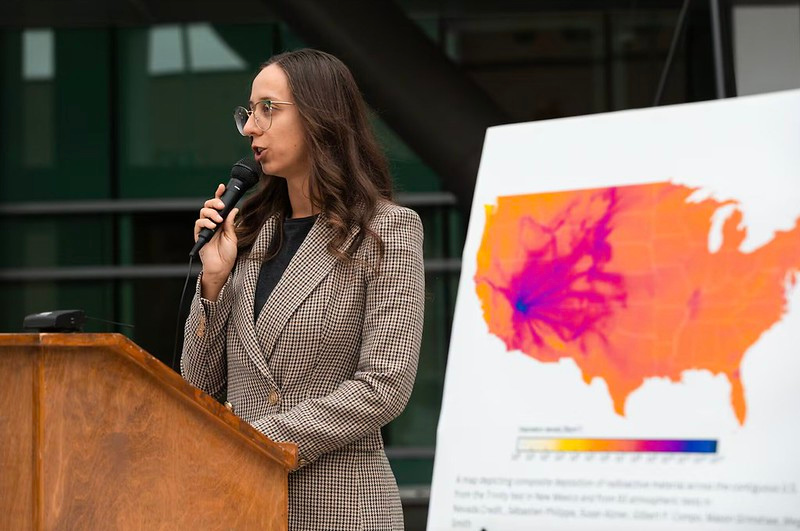
- Healthy Environment Alliance of Utah, or HEAL Utah, has been a grassroots advocacy organization based in Utah for over 26 years. Carmen Valdez, HEAL’s Radioactive and Toxic Program Manager, focuses on the legacy radioactive issues to the present and future threats to our health. While supporting the Radiation Exposure Compensation Act and fighting to expand the program to include all of Utah and other previously excluded communities, HEAL also actively monitors and fights against nuclear threats such as proposed reactors, test sites, uranium mining, milling, and processing, and the dumping of high-level radioactive waste in the state.
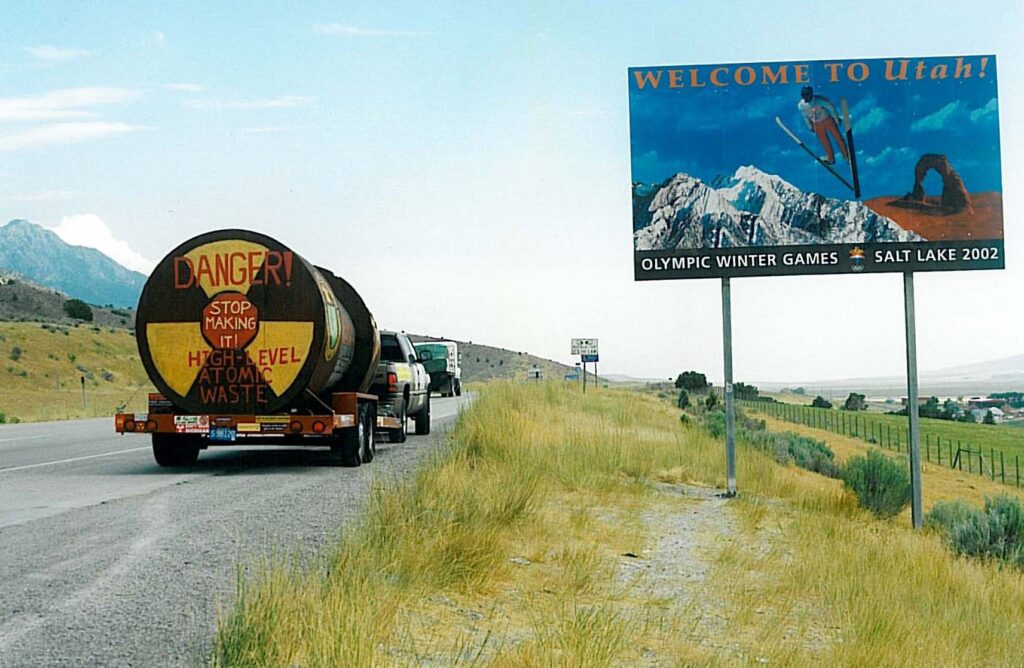
Radioactive Warning welcome to Olympic Winter Games visitors, 2002
Numnutz of the Week (for Outstanding Nuclear Boneheadedness):
No, Senate – DON’T DO IT! $50-billion U.S. taxpayer dollars for three nuclear “hubs,” uh, no, “campuses,” uh, no, “ (truth in advertising:) FUTURE RADIOACTIVE WASTE TOXIC SUPERFUND SITES!!! (SEE: Piketon/Portsmouth, OH for the kind of mess we’re talking about.)
LINK to the full Numnutz article:
Newsletter
Get a Free Excerpt from Yes, I Glow In The Dark!
Join the mailing list for weekly episode alerts and Libbe's free book excerpt.