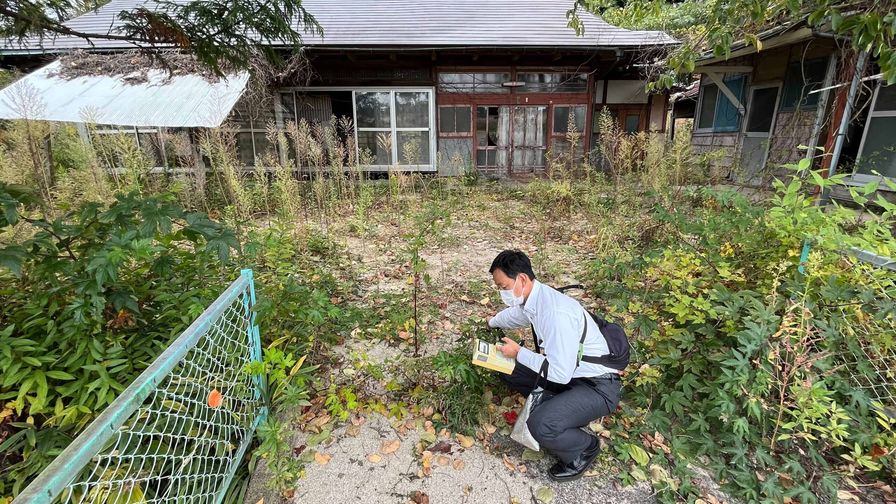
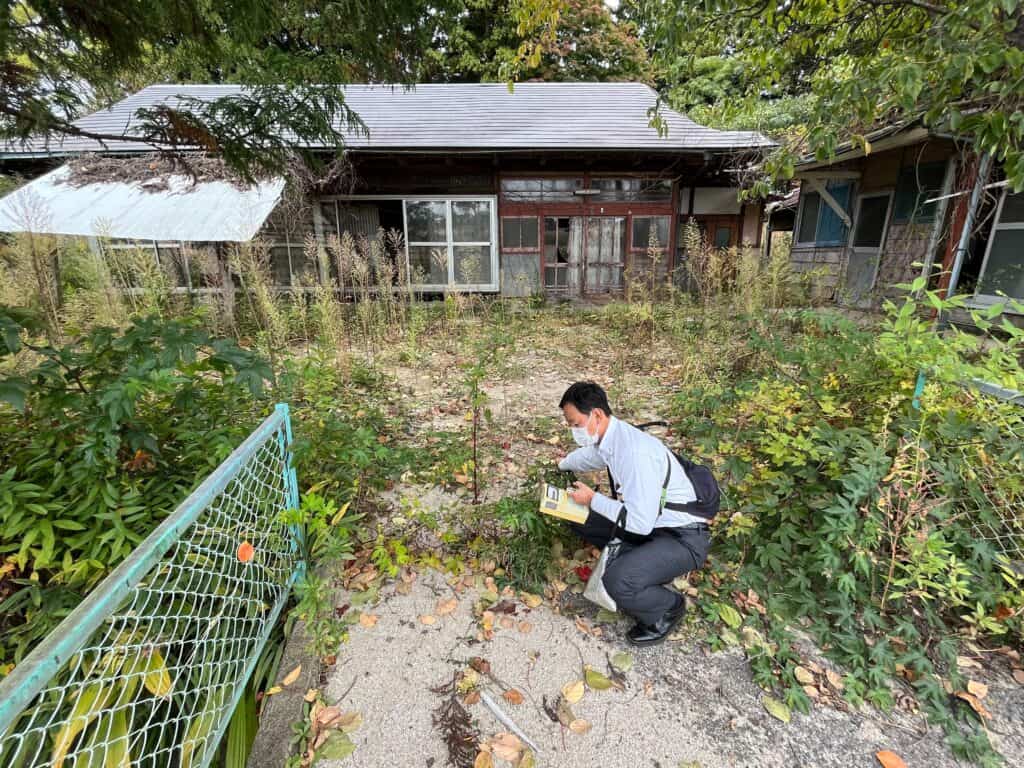
Abandoned home, Tomioka, Fukushima Prefecture, five miles from Fukushima Daiichi. Tomioka resident Yuki Saito measures radiation in the weeds outside the home. Photo – Yuji Kaneko, used by permission of the photographer.
Fukushima 12th Anniversary: Voices from Japan, On the Ground w/Beverly Findlay-Kaneko
This Week’s Special Featured Interview:
Beverly Findlay-Kaneko provides an “on-the-ground in Japan” report on the current situation faced by people living with the aftermath of the 2011 Fukushima Daiichi nuclear disaster. Beverly lived in Yokohama, Japan, for 20 years until March 2011, after the Great Eastern Japan Earthquake and the start of the Fukushima nuclear disaster. She worked at Yokohama National University and The Japan Times. Beverly has a Master’s degree in East Asian Studies from Stanford University and speaks Japanese fluently. She is the producer behind our Voices from Japan series and this year is the Voice from Japan.
I spoke with Beverly Findlay-Kaneko on February 27, 2023.
Yonomori Denim – Sho Kobayashi’s business attempting to help rebuild Tomioka in northeast Japan. You can follow them on Instagram: @yonomori_denim . And here’s a QR code, for those who understand how to use one:
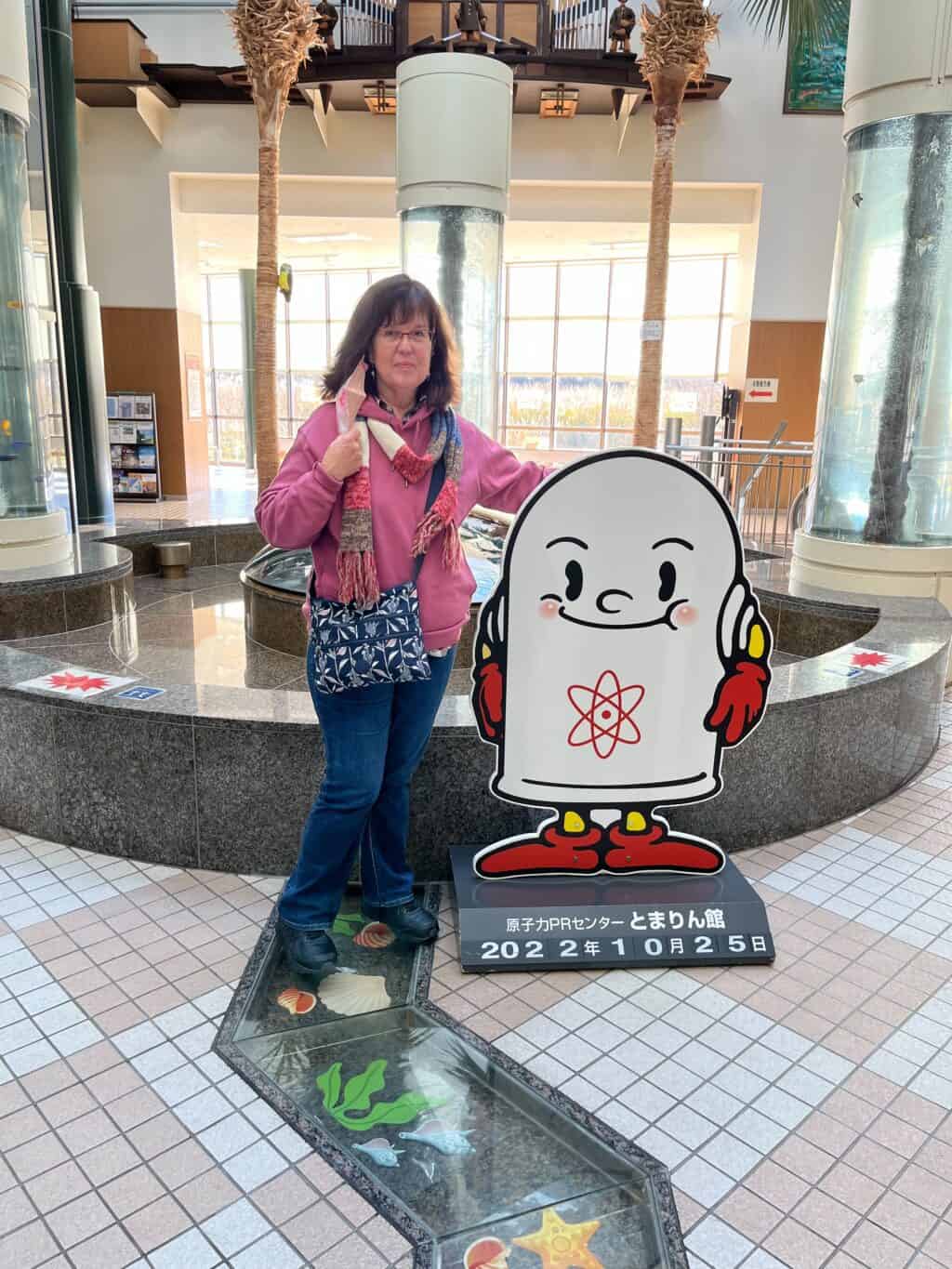
Tomarinkan Nuclear Energy PR Center, Tomari, Hokkaido: Beverly Findlay-Kaneko with the Tomarinkan Mascot cartoon character. (Nicknamed Mr. Nuclear Condom). Photo – Yuji Kaneko, used by permission of the photographer.
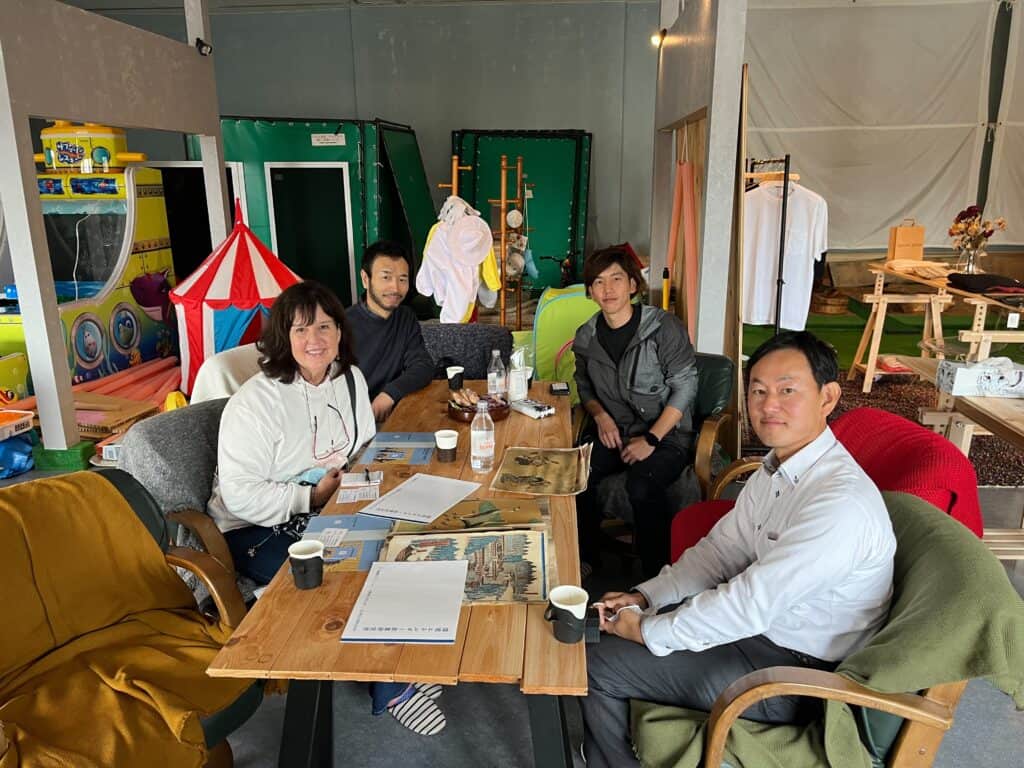
Yonomori Denim Shop and Meeting Space, Tomioka, Fukushima Prefecture, five miles from Fukushima Daiichi. Beverly Findlay-Kaneko (front left) and Yuji Kaneko (rear left), meet with Yuki Saito (front right) and Sho Kobayashi.
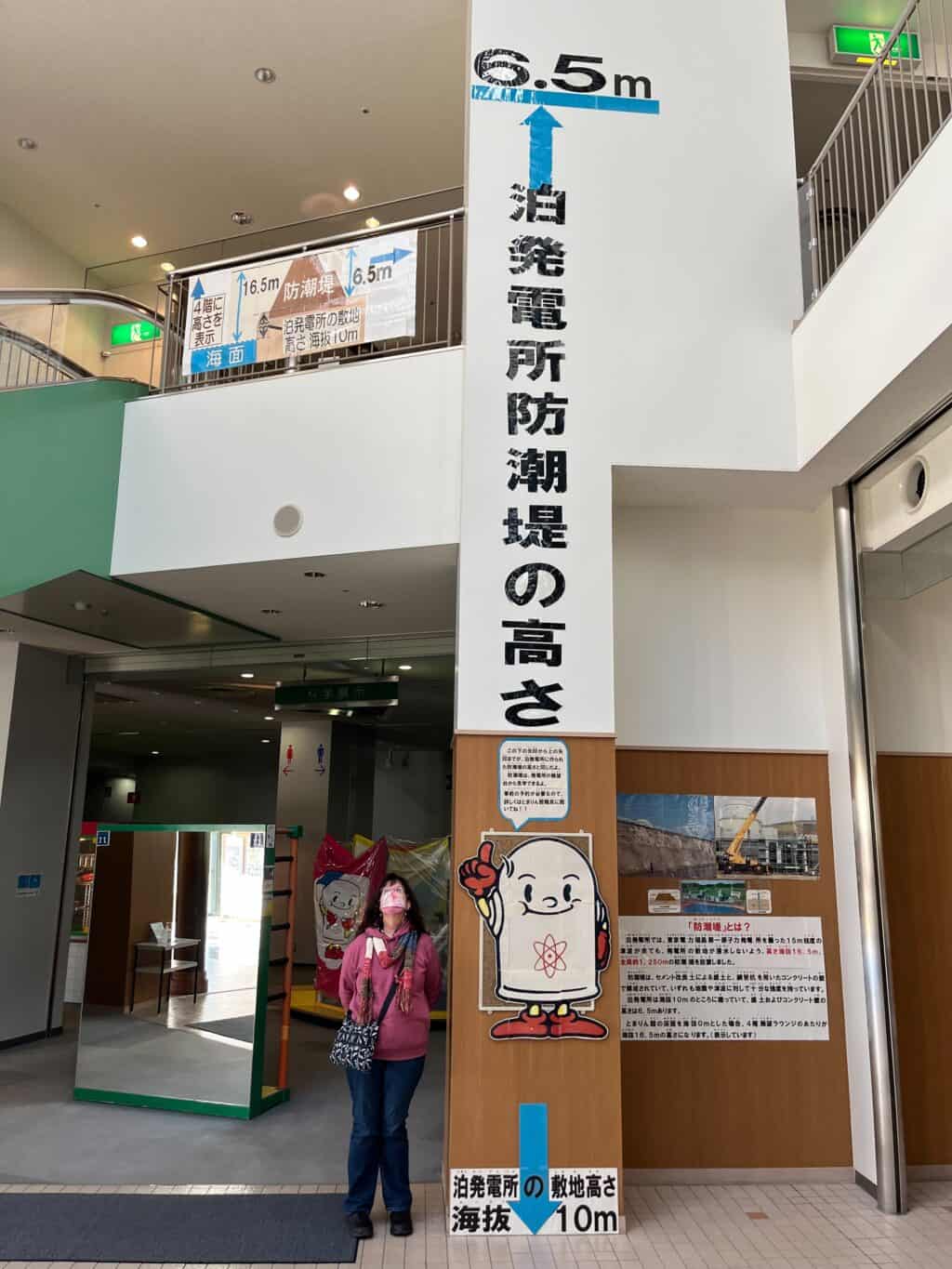
The “Nuclear Condom” and the pillar that marks the height of the sea wall at Tomari Nuclear Power Plant. It’s just one meter taller than the one at Fukushima. Photo – Yuji Kaneko, used by permission of the photographer.
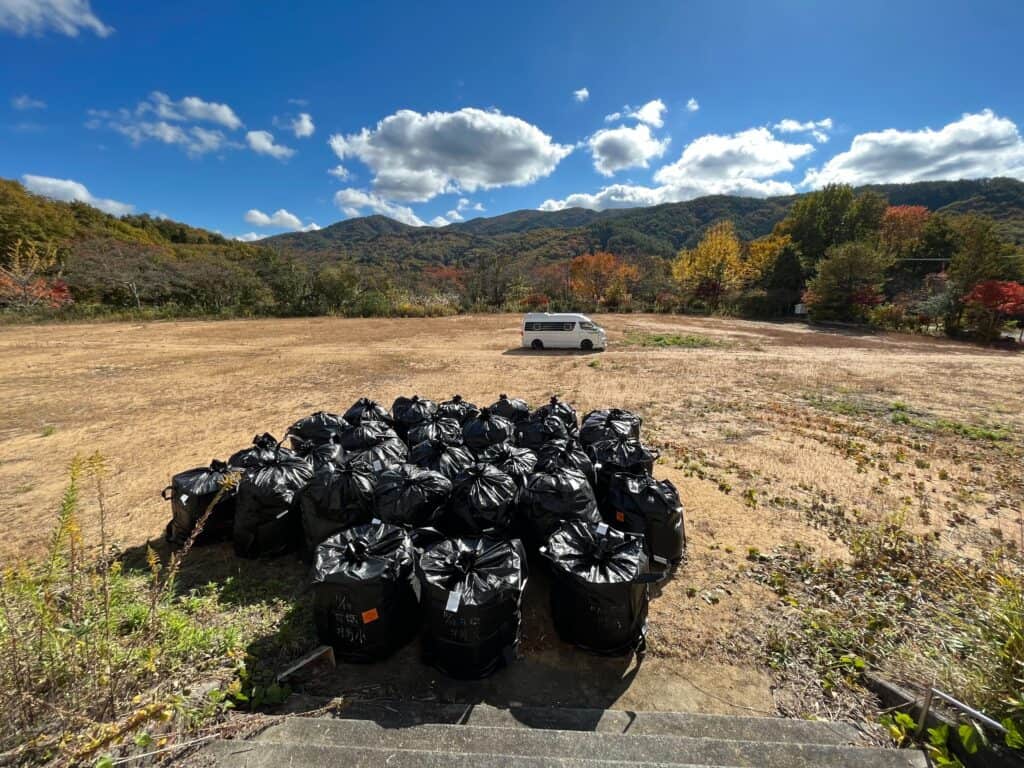
Abandoned Tsushima Elementary School Athletic Ground, Tsushima, Fukushima Prefecture. As one of the last towns to have evacuation orders lifted, Tsushima has been left behind in decontamination efforts. Bags like these, containing radioactive debris and soil, a rare sight in other parts of the prefecture, are ubiquitous here. Tsushima is, for all practical purposes, a ghost town. Photo – Yuji Kaneko, used by permission of the photographer.
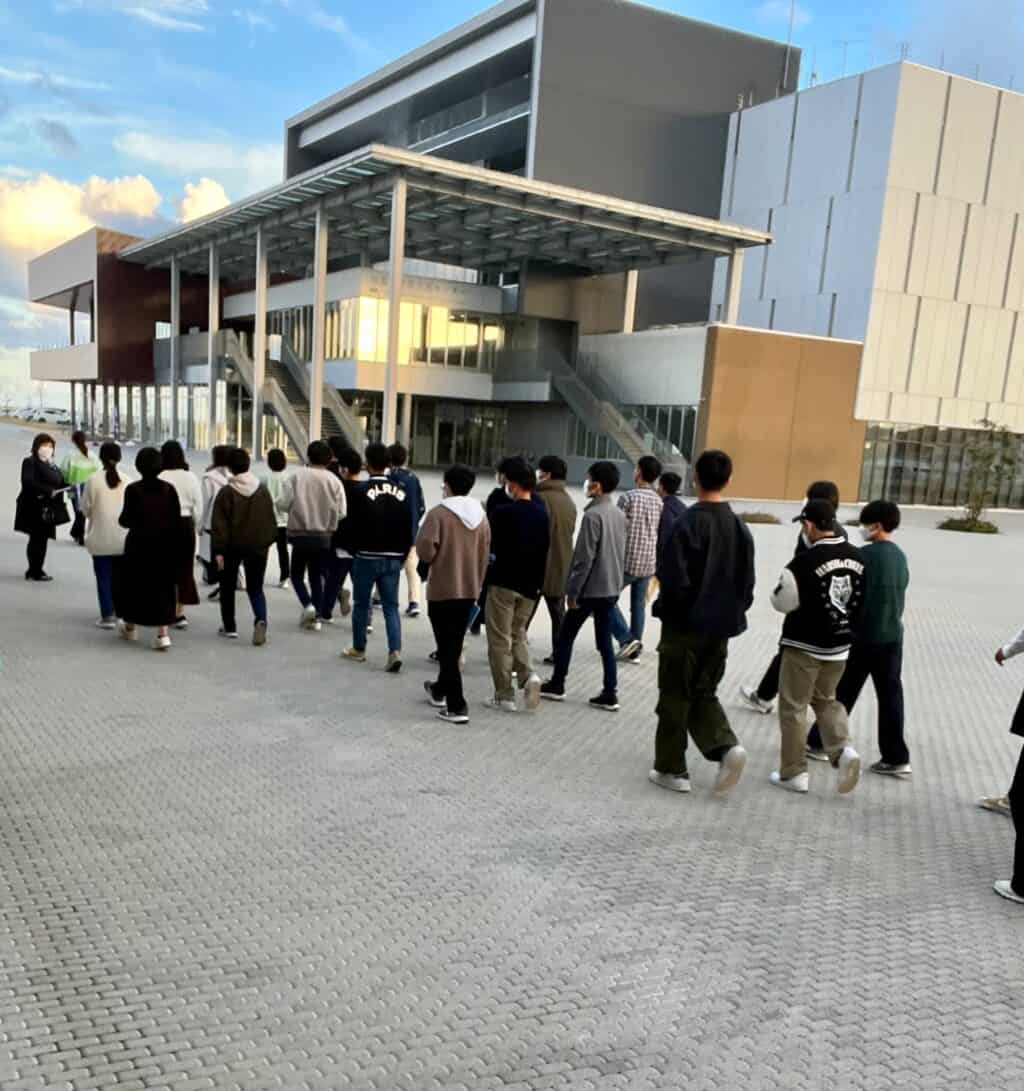
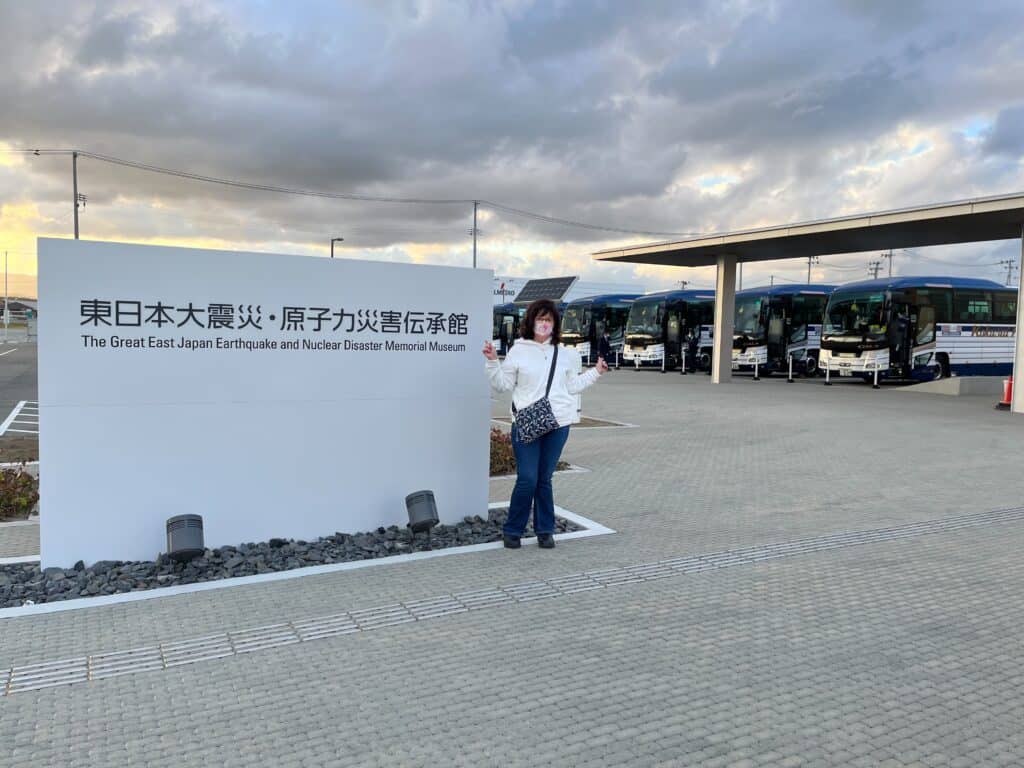
Denshoukan, the Great Japan Earthquake and Nuclear Disaster Museum, Futaba, Fukushima Prefecture. Fukushima is just over the hill, a couple of miles away. Student visitors to the museum flocking back to their tour busses. Photo – Yuji Kaneko, used by permission of the photographer.
Denshoukan, the Great East Japan Earthquake and Nuclear Disaster Museum, Futaba, Fukushima Prefecture. Fukushima Daiichi is just over the hill, a couple of miles away. Beverly points out fleet of tour busses parked and waiting for high school students inside. Photo – Yuji Kaneko, used by permission of the photographer.
Episode Transcript
Nuclear Hotseat 3-7-2023
The Court of Public Opinion
In the runup to the 12th anniversary of the Great East Japan Triple Disaster, earlier this month, the Asahi Shimbun conducted a nationwide survey to gauge public opinion on nuclear energy. It was the first time since the Fukushima Nuclear Disaster that the majority of people were in favor of restarting Japan’s nuclear power plants, which were shuttered in the wake of the accident. 51% answered in favor, and just 42% were opposed.
Since the accident, those in favor of restarting Japan’s shuttered reactors has wavered around 30%, and those opposed were 50-60%. Even as recently as last year, only 38% said they approved of giving nuclear another chance, while 48% were against it.
Reflecting this shift in public approval, Prime Minister Kishida’s administration has committed itself to a nuclear renaissance. But the government may not yet have as solid of a public mandate as it hopes for. The Asahi survey asked about the administration’s plans to rebuild nuclear power plants. The respondents were split down the middle, with 45% approving and 46% disagreeing with the government’s plans. It could be that support for nuclear is just aspirational, but when it comes to huge investments of tax money, people are more skeptical.
WHY are people in Japan more open to nuclear?
There are four main reasons that public opinion has shifted so dramatically in just one year.
First, as with everywhere else, the war in Ukraine has led to huge increases in fossil fuel prices, making people reconsider nuclear as an option. There is the wrongheaded notion that nuclear is “cheap,” and that there are all of these reactors sitting around that can be restarted. People might balk at investing in expensive new projects, but don’t really think about the costs involved in restoring brittle, aging nuclear infrastructure.
Second, the effects of global warming are felt keenly in Japan, which has been experiencing ever-stronger typhoons and flooding, freezing winters and summer heat that has become unbearable. In the push to decarbonize, nuclear is considered to be a climate-friendly option, even though it really isn’t.
Third, it has been a dozen years since the Great East Japan Triple Disaster. Aside from the annual nod to the issues in the media, it really isn’t on top of people’s minds anymore. There have been so many big events since then that have dominated the news cycles: the Olympics, COVID (which, by the way, is not considered to be “over” in Japan, where everyone masks, even outside), Prime Minister Abe’s assassination, and so on. Fukushima has moved from the current events section to the history shelves.
Related to that is number four: the “P”-word.
Propaganda?
Yes. All along, there has been a concerted effort to minimize the effects of the disaster. We’ve discussed so many of these over the past decade of coverage here on Nuclear Hotseat:
the notion of people spreading “harmful rumors” about Fukushima if they dare to question the safety of food products or raising children in a radioactive environment;
the twisting of pediatric thyroid cancer statistics and outright denial that highly elevated numbers of victims in Fukushima is related to the nuclear accident;
nationally distributed educational materials for children that gloss over the dangers of radiation and minimize the seriousness of cancer;
promotional tours for students and international visitors that are crafted to showcase Fukushima as a “safe” destination;
museums that skirt around the issues;
promotional events in unsafe areas that make it seem like life has gone back to normal when it hasn’t.
Aside from another accident, is there anything that might cause the public opinion pendulum in Japan to swing back toward antinuclear?
Yes, I think the public is very wary, especially if they think it might affect their own daily lives. In the early days after the disaster, there was a largely ineffective outcry in Kansai and other areas when possibly radioactive tsunami rubble was shipped nationwide for incineration. That brought the disaster home for people around the country, at least for a while.
We still pay a special tax for “Post-Disaster Reconstruction” every year during tax season. It’s a line item on the tax returns. When I do my U.S. taxes, I have to translate and explain that to my CPA. That’s an annual reminder to every taxpayer, and I know people complain about it.
Recently, the government has plans to start shipping “quote unquote” “decontaminated soil” from Fukushima’s vast stockpiles of the stuff to other places around Japan for experiments that will eventually lead to use in public works.
Why the quote marks around “decontaminated”?
Because it is really contaminated soil. It’s just under the limit to be considered nuclear waste. But the government raised that limit in the wake of the Fukushima accident. In other words, soil this contaminated would have been considered nuclear waste pre-Fukushima.
Can you tell us more about the program?
NHK news reported that initial shipments are planned for Shinjuku Gyoen National Park, which is one of Tokyo’s largest and most popular parks, in the middle of one of Tokyo’s busiest districts. It’s also going to an Environmental Research Facility in Tokorozawa City in Saitama, a suburb in the northwest part of the greater Tokyo Metropolitan area. The government will proceed after it gains the “understanding” of area residents.
Do you mean this is consent-based siting?
Well, we both know that’s loaded terminology. It’s hard to tell. In December 2022, public information sessions were held in both areas. Usually, those sessions are more like Southern California Edison’s Community Engagement Panel here in San Onofre. There’s a lot of explanation with very limited opportunity for public comment and real dialog.
Concerning the Shinjuku park and Saitama research center soil experiments, locals were left wondering why those particular areas were selected and felt that they were given too little information about the projects.
The mayor of Tokorozawa said that a majority of citizens in his city were opposed to the project.
So, what does the government plan to do about it?
The Environment Ministry said that it plans to start the projects within the year, and to that end will provide written answers to questions that were raised during the information sessions, and hold additional public sessions if needed. It will then reevaluate plans to begin the projects.
Anyway, there is a lot of soil and debris that needs to be dealt with one way or another. The government promised Fukushima Pref. that it would be shipped around the country, so I think Fukushima will be on more and more people’s minds when the waste ends up in their own backyards.
So, you did some traveling in Japan recently. When and where did you go?
We were there in October and November 2022. We visited Hokkaido in October to catch up with family in Sapporo and to take a road trip around the Shakotan Peninsula. In November, we spent several days traveling around Fukushima with an old friend in his camper van. He camped and we stayed in hotels. Strangely enough, we also encountered nuclear insanity in Hokkaido.
Wow! What did you come across there?
We were on a scenic drive around the Shakotan Peninsula. In November, it’s a pretty desolate place. In the summer, apparently there are huge traffic jams, as vacation goers seek out the seaside views and sea urchin, which is a local delicacy. In November, it’s abalone season, but it’s cold and remote, so it’s less popular. It’s beautiful, but pretty desolate, with all of the sea urchin shacks and fishermen’s huts boarded up for the winter.
As we circumnavigated the peninsula, winding our way through dark tunnels and back into the bright sunlight, Yuji and I were on the lookout for Kamoenai Village. It has a population of 904, but has been in the national news as one of two local towns—the other is Suttsu—that are vying for the honor to host permanent storage of all of Japan’s nuclear waste. If the plans come to fruition, the towns will receive billions of yen in subsidies. There has been fierce opposition from neighboring towns and villages. It’s a lot to go into here, but there’s a good article in the Asahi Shimbun that describes the conflict.
We’ll post a link on Nuclearhotseat.com
So, while I think we saw a sign for the village, I think we missed it all together. At least along the coastal highway, it was nothing more than a handful of aging small buildings and homes.
A little farther down the highway, things started to look decidedly more swanky. There was a big fancy school set into the hillside, among other newer, relatively expensive looking buildings and homes. And then, to the right, suddenly there was a huge museum surrounded a hilly lawn. It was the Tomarikan Nuclear PR Museum. We had arrived at Hokkaido’s nuclear village. Of course, we had to stop.
Tomari Nuclear Power Plant is located nearby. You don’t see it from the highway, as it is obscured by cliffs and hills.
Is it operational? Or will it be restarted?
No, it was shuttered in the wake of Fukushima, and it couldn’t meet post-Fukushima safety standards. Hokkaido Electric has been pushing for a decade to get the plant back online, but they can’t seem to bring the plant into compliance. In May 2022, the Sapporo District court ordered that it remain offline due to safety issues. Hokkaido Electric keeps trying, and the plant was supposed to ready to be reevaluated in September this year. However, it looks like they’ve postponed until December due to tsunami safety issues. Other issues on the laundry list include earthquakes, volcanoes, as well as a problematic sea wall.
How about the museum?
It was much of what we’ve come to expect from similar facilities in Fukushima. Lots of stuff to make nuclear seem happy and familiar. There were several fun, hands-on things for kids on field trips to fool around with. There was a grinning cartoon character in the shape of a nuclear reactor wearing red gloves and socks. Actually, it looked a bit like a condom. There was a giant pillar marking 6.5 meters, which is the height of the Tomari Nuclear Power Plant Sea Wall. I guess that’s supposed to prove that it’s safer than Fukushima’s wall, which was only 5.5 meters. Apparently, you can make special reservations to view the seawall from the observation platform at the nuclear power plant. And, there was an entire room behind glass filled with Jomon Era pottery from 14,000 to 300 BCE. I assume it was dug up when they constructed the power plant. There were cute handouts and a map out front directing visitors to local tourist spots.
On this chilly October day, we were the only people at the museum.
What make the biggest impression on you about this museum?
I think that more than the museum itself was the striking difference between the surrounding boarded up and desolate fishing villages and all of the sudden you are in a visibly well-off area, and through the next tunnel, you are back on the road lined with shacks that have been boarded up for the season. Obviously, the mayors of waste-dump candidates Kamoenai and Suttsu are grabbing for a handful of that nuclear glitter to spiff up their own little towns.
Fukushima is the same way, with struggling mountain hamlets and seaside villages acquiescing to and benefitting from the nuclear industry. It’s just not quite as jarring as this particular area in Hokkaido because Hokkaido’s landscape is more stark and dramatic, and Fukushima’s is more bucolic and heavily forested, which masks some of the poverty. Little farmhouses nestled in among the trees and paddy fields are quaint, but rickety, boarded-up fishing huts hunkering beneath towering stone cliffs give off an air of desperation.
Reflecting on this, it seems odd to me that one mayor in an impoverished village of 904 can make a decision to store all of Japan’s nuclear waste, or that a little town of 2,000 can decide to host a nuclear power plant that has the potential to obliterate everything around it. But Yuji pointed out that it’s easier to buy off 904 struggling fishermen than the population of Tokyo. Kamoenai and Suttsu can receive around $19 million just for the first two years of the research phase of the project. That’s a drop in the bucket if you consider what it would cost in a more populated area to convince people to go along.
So, you went to Fukushima, too, last fall
Yes, we were in Fukushima in November.
Where did you go?
Yuji retraced some of his footsteps from his trip in 2021, but aside from Tomioka, Fukushima City and Koriyama, much of what we saw was new to me. I hadn’t been to Fukushima since pre-pandemic in 2019. Actually, a lot of it was new to Yuji, too, because the Japanese government took down barricades and opened up a lot of the “difficult to return” zone in the runup to the Olympics.
We visited Iitate Village, which is about 40 miles northwest of Fukushima Daiichi, to check up on some things Yuji had seen previously. That area was extremely contaminated due to changing winds in the wake of the accident. From there, we traveled to visit Tsushima village.
We poked around a bit at the Futaba Station area where Yuji visited previously, and went to Denshokan, the Great East Japan Earthquake and Nuclear Disaster Memorial Museum.
We spent the night at J-Village in Naraha. That’s the Olympic soccer training center that served as base camp for the decontamination workers from Fukushima Daiichi.
Where did you go on Day Two?
We went to Tomioka, where Setsuko Kida used to live. I had been there in 2019 with Yuji, Kida-san, and Shinshuu Hida. This time, we visited Yuki Saito, who is the owner of a company called Fukushima Environmental Research and Development, and
, a young man that works with him.
We spent the night in Koriyama and caught up with Shinshuu Hida for coffee on our third morning.
Can you give us some of the highlights of your travels?
Our friend Sen-san drove us around in his camper van. He is a retired elementary school principal from Fukushima City who took care of his students during and after the triple disaster. He’s an active and jovial guy who in retirement started a non-profit that aids schoolchildren in Vietnam and Laos. Still, traveling with him through Fukushima, you can tell that the wounds from the nuclear disaster are not far from the surface. He is still very tuned in to what happened to schools and children and had a lot of good information and stories, but tended to remove himself from the scene when it got to be too much. We’d be poking around at whatever we’d stopped to see, and Sen-san would take a quick look and go back to hang out with a cup of coffee in his campervan. I remember traveling with him on my first trip to Fukushima in 2014, and his normally wide smiling face closing in on itself as he looked out on a the blackened remains stand of persimmon trees that a farmer had poisoned because he could no longer sell their sweet fruit.
On this trip, we stopped at the remains of Ukedo Elementary School, which was engulfed in the tsunami. All of the children were able to take a trail through a farm up a hill, where they were picked up by a trucker and driven to safety. The ruins of the school have been preserved and made into an exhibit that you can walk through. It was heartbreaking to see the warped and buckled gymnasium floor, the mostly empty cubbies, and debris like shoes and books strewn in the corners. There was a room with a bulletin board that displayed student compositions collected post-disaster. A young man who looked to be in his early twenties stood in front of that bulletin board sobbing. Sen-san started walking through the school with us, but quickly removed himself to the parking lot.
Twelve years in and the hurt is still there. You want to move on, but can’t because the experience is part of who you are.
Libbe—Maybe make a comment about Three Mile Island folks or something here. . .So tell us more about where Sen-san took you.
As I mentioned earlier, we went to Iitate. The road there was heavily forested, and it can’t be decontaminated. Rainwater washing down these forested hillsides is what keeps the cycle of contamination going.
There are a lot of empty homes and fallow fields dotting the highway from Fukushima City to Iitate. Still, the hillsides were ablaze with color and it was beautiful.
We passed Onami village. Everyone left, taking their children with them, and the elementary school we passed was closed and abandoned. The last solitary student graduated in 2013 and left the area. It was in the news at the time. Sen-san’s friend had an apple orchard in this area, but he gave up and left, too.
In the same area, Oguni village, has no young people around anymore. Sen-san told us that no matter how many times they ground down the surface of the concrete around the school, they couldn’t bring down the radiation levels, so the school had to close. Sen-san oversaw the same process with more success at the school where he was principal. It was still an arduous process that took a lot of time. The waste from these efforts was stored onsite for an extended period. We visited Sen-san’s old school in 2014, and he went around checking all of the hotspots with his Geiger counter, still concerned about the children’s well-being.
As we approached Iitate, there were still “Do Not Enter” signs blocking side roads, and some heavy machinery on the fields that appeared to be scraping soil. This kind of scene is no longer common in more populated areas, which have already been deemed decontaminated and soil carted off to interim storage. But here, soil scraping and black bags are ubiquitous again, but most of the fields appear to be cared-for and weed-free.
We passed a block of newish post-disaster recovery housing. In town, rice paddies have been harvested. We made a quick stop at the fancy community center/rest stop. It was pretty busy. The little farmer’s market had quite a bit of local produce for sale, and there was still a man in the corner running radiation detection equipment if you wanted to check if something is safe or not.
We then went to go check out the new school, Iitate Hope Village Academy, that was built with an obscene amount of Reconstruction funds.
We talked about that school with Iitate resident Nobuyoshi Ito in Nuclear Hotseat ___ in 2021.
Yes. At the time, he mentioned that the school had around 100 students. They commute from elsewhere because they get so many government benefits for attending. Still, given the size of the school facilities, 100 students doesn’t seem like a large student body, as it is from preschool through jr. high. That’s an average of about 8 students per grade level.
When we were there, we stood above an athletic field and track. It was huge, brand new, and made with high-end modern materials. There were giant night-lights surrounding the field that looked like they belonged in a baseball stadium. A class of 5 or so 3rd grade level students were playing in the middle of the field under the supervision of their teacher.
In contrast, my son’s school in Yokohama recently moved and rebuilt in another part of the city on a larger piece of land. That whole school could fit into the athletic field in Iitate Village!
Sen-san and I stood chatting next to his van while Yuji went to rustle around in the brush with his Geiger counter. He found that the radiation levels were inconsistent around the school, registering 0.8-0.9 micro sieverts per hour at the edge of the parking lot. Obviously, the kids need to be careful not to stray from specifically decontaminated areas. The hill in back of the school has been completely stripped of vegetation. I wonder if that’s an area where children can play, even though it doesn’t seem very attractive. It might be a good sledding hill in the winter, though.
Next, we headed to Tsushima.
That name doesn’t sound familiar? Have you visited there before?
No! Route 399, which takes you to Tsushima, just reopened in Sept. 2022. This heavily forested area was in the exclusion zone and was inaccessible previously due to road closure.
The difference between Iitate and Tsushima was jarring. Initially, there were a few harvested rice paddies, but then more and more weed-choked fields. There were trucks carrying bags of dirt, I assume to interim or temporary storage. There were vast swathes of fallow but weed-free fields. There was decontamination work being done in the distance. We passed a roadside radiation monitor that read 0.26 micro sieverts per hour, and the alarm inside the car was quiet.
We wondered about some of the workers, who weren’t wearing much in the way of protective gear. Sen-san said that one time he spoke to an unmasked guard along Route 6, and asked him if he knew it was dangerous. The guard said he did and that it was enough that he could work and send money to his family up north in Hokkaido.
All along, it seems that the impoverished have been recruited for decontamination work. Were there any barricades along the road like you have seen in previous visits?
Yes, along Route 399, there were barricades alongside the road tentatively blocking access to the difficult-to-return zone.
As we approached Tsushima, there were more and more abandoned homes. The village is open now, but it was empty. It was Halloween that day, and here we were in a real ghost town. Time had completely stopped. There was an abandoned health clinic and Jr. high school. Tattered curtains fluttered out of broken windows. The athletic ground in front of the school now serves as a parking lot for construction vehicles, and there was a radiation screening center alongside the road leading to the Jr. High school. There was a large sign detailing decontamination plans posted in front of the school, and decontamination bags were piled up.
We moved along to the village elementary school, which was completely bereft of life. The school athletic ground was weed-choked and decontamination bags sit in a pile.
Aside from a few workers and one ancient farmer tending a little plot of vegetables, there was absolutely no one around. It was hard to gauge how many people actually used to live here. Sen-san gazed up at the elementary school building and said, “It’s a splendid building. What a waste. There were probably two classes per grade.” In the crisp fall air, I could almost hear the 360-students and their families cheering and laughing at the annual school sports festival.
Yuji took his Geiger counter and camera and picked his way through the weeds and onto campus. Sen-san and I stayed in the parking lot. He quickly returned, and said that the Geiger counter alarm went off around the swimming pool.
Farther up the road, we stopped at the brand-new Tsushima Village Town Hall. Yuji went in and said there were only two people working. There was a block of public housing being built by Sekisui House next door. Apparently, this is for the “official” reopening in March this year. As of the time of our visit, no one could actually live in Tsushima. It will be interesting to see if anyone does decide to live there.
The difference between Tsushima and areas that have been given lots of money for decontamination and reconstruction is shocking. Up until now, the government has done nothing for Tsushima, so the town is suing the government.
After Tsushima, we headed in the direction of Fukushima Daiichi and the towns of Namie and Futaba. The Geiger counter alarm started going off in the car, registering 1.65 micro sieverts per hour. There was decontamination work going on in the area and we passed an incinerator. It was reminiscent of scenes we encountered closer to Fukushima City in 2014.
You’ve been to Futaba and Namie before, right?
Yuji was in Futaba in 2021, and we both visited Namie and the tsunami memorial in 2019 with Kida-san and Hida-san. This time, we visited a big convenience store in Namie to get some drinks, and headed to the Great East Japan Earthquake and Nuclear Disaster Memorial Museum in Futaba.
When Yuji visited last time, he said that it was boring and dry and didn’t communicate any emotion or urgency about the disaster. There were many similar complaints, so the government upped its game, and the result is over-the-top. There are video screens inset into the walls with victims relating their experiences. There is a special room for live presentations. There is sound everywhere, and interactive maps, and so much flashy stuff going on that it is distracting and counterproductive.
There are large groups of high school students being shepherded through by fast-talking docents. There are attendants posted at doorways to tell you which way to walk. We got yelled at for “going the wrong way” because it is “dangerous.”
We finally settled in with a group of students and started to listen to one docent’s spiel. Well, it was full of lies and half-truths, and went out of the way to absolve anyone of responsibility for the accident. For example, he said it couldn’t be helped because no one predicted this big of a tsunami.
Ummm, no, scientists had warned that the sea wall wasn’t high enough for the size of a possible tsunami.
Right. And Tepco ignored the advice, and that is one of the main pillars of the court decision against them. Furthermore, the docent said Fukushima Daiichi was an American design—correct—and that there are no tsunamis in America, only tornadoes and hurricanes so that American designs are too weak for Japan’s environment.
OKAY. . .
Well, I went up afterward and corrected him on the second point, and Yuji scolded him at length about the first point. It turned out that the man himself was a retired teacher from Fukushima—Soma in the northern part of the coastal area—and he knew these things but had been told this is what he is supposed to say to museum guests.
Next, we went into a room that was lined with displays and interactive videos about the process of decontamination. There was a group of 5 or 6 teenage boys being teenage boys, pushing buttons, looking at the pictures, and laughing, saying, “That job looks easy, even I could do that.” Yuji, bless him, since their teacher was not around, took those boys aside and explained that the workers were doing a dangerous job, and that sadly, it’s not an easy job, and nearly always fails because things become contaminated again when it rains, etc. The boys were from Fukuoka, on the southern island of Kyushu. Sen-san told us that Fukushima Prefecture has money to bring student groups from other parts of the country.
Finally, I couldn’t stand it anymore. It was total sensory overload. We went out to the parking lot, where there were at least five sleek black luxury tour busses waiting for the students.
We got back into Sen-san’s more humble form of transportation and headed to J-Village in Naraha to spend the night.
So how was J-Village? I remember you mentioning before that there is a hotel attached and tourists can stay.
It was actually very nice. The rooms looked out onto the pitch. The lobby had displays detailing the facility’s role in the aftermath of the disaster. It is being used as an active soccer training facility. There were Spanish-speaking guests in the restaurant that seemed like they might have something to do with soccer.
Didn’t Arnie Gundersen survey that area a few years ago when he went to Fukushima to collect samples?
Yes, I do realize that Arnie Gundersen and someone else found some elevated radiation readings in the dirt along the roadside or in the parking area at J-Village in the lead-up to the Olympics. I wish that visitors had a little bit more information about some of the risks they are taking and how to protect themselves when visiting. J-Village is in Naraha, which is south of Fukushima Daiichi. It was on the edge of the exclusion zone initially, and was one of the first towns where evacuation orders were lifted in 2015. So, it seems natural that there are hotspots. Residents have been slow to return, and we found that what there was of a town rolled up its sidewalks pretty early in the evening. The J-Village hotel wasn’t serving dinner, so we drove into town to what looked like a fairly new shopping center to grab dinner. There was only one restaurant open and the chef was the only person working, so he could only offer two kinds of pizza and some salad. That was OK with us.
I did not feel uncomfortable staying at J-Village, but I would hate to see naïve visitors rent a car and venture up the coast to the former exclusion zone areas without the proper information. And there is really nothing stopping anyone from going anywhere they please at this point.
It sounds like it, since you weren’t able to drive right through what was the exclusion zone until recently. Didn’t you travel along Route 6 in 2019, where the side roads were all barricaded for miles and your Geiger counter kept going off?
Yes. But all of those barricades are down now because of the Olympics. You might not be able to live there, but you can walk around freely. This was really apparent when we stopped at Futaba Station after we visited the Great East Japan Earthquake and Nuclear Disaster Memorial Museum.
There are no barricades blocking off side streets from the station area. You’ll remember just a couple of years ago, Hida-san had shown us the extremely high measurements he had taken in the nearby areas. It is still a very contaminated place.
When we stopped by, the area was completely devoid of people. There was no one using the train station. Yuji found a couple of officers in the police box, and we saw one police car patrolling, but otherwise, we saw no one.
But the area has undergone an odd revitalization. It almost seemed like a Universal Studios set. Just a façade. The area around the station has been coined the “Futaba Art District.” There are murals on the sides of buildings. There are rent-a-cycles. There’s a train. You could conceivably arrive on the train, hop on a bike, take a selfie in front of a mural, and ride to the Disaster Museum. There’s nothing anywhere telling you not linger on the side of the road while you have a snack of rice balls and juice. As tourists start to flock back to Japan to take advantage of the cheap yen, I wonder how many will stray up this way and take advantage of this opportunity to shock people on Instagram.
So, after Futaba, and J-Village in Naraha, where did you go next?
After breakfast at J-Village, we walked down to the lobby, where we saw quite a few high school students milling around waiting for the big black busses parked outside to whisk them away to their next propaganda session along Fukushima’s “Innovation Coast.”
We headed along Route 6 to Tomioka. I hardly recognized the road without the barricades blocking the side streets, and didn’t realize it until it dawned on me that all of the buildings along the road remained untouched and abandoned. I noticed but one “decontamination in progress” banner along the way. This time the Geiger counter was silent, at least along this stretch of road. It was 0.22 micro sieverts per hour inside the car.
We passed the Sakura Mall where we ate lunch with Setsuko Kida and Shinshuu Hida in 2019. There were more regular cars parked there than in 2019, when most of the vehicles were trucks involved in decontamination and reconstruction. Still, the majority were trucks.
What did you do in Tomioka?
In Tomioka, we had the pleasure of meeting Yuki Saito, the president of Fukushima Environmental Research and Development, and Sho Kobayashi, who works with him.
The best way I can describe the two of them is as reconstruction pioneers in the former exclusion zone. Theirs is kind of a David and Goliath effort.
Saito-san’s main business is providing maintenance for the solar farms that have sprung up on many of the fallow farm fields around Tomioka. This involves things like using robots to mow the weeds, and so on.
He is in his early 40s, and has a wife and two young children: a toddler and a 5-year-old. They were living in Iwaki far in the southern end of the prefecture, and he commuted. That was difficult, and he had a hard time dealing with the old-timers whose solar farms he was looking after. He was seen as an outsider. So, he decided to move his family to Tomioka to see if he could make it work.
How many people live in Tomioka now?
Saito-san said the population is about 2,000, but most are decontamination and reconstruction workers. There are very few families with children. He said that there is one school in the whole area and that counting all grade levels, there are at most 30-40 kids combined. Kobayashi-san, who was a middle-schooler at the time of the accident, said that there were about 160 kids per grade level back then. Most of the residents who left Tomioka have made their lives elsewhere and have no plans to return.
How has moving to Tomioka worked out for him?
Business-wise, he is having an easier time dealing with the locals, who listen to him now and have come to rely on him in many ways. He was a laughing that he has been thrust into many of the town leadership roles and he’s even a fire volunteer. As he evaluates local needs, he is expanding into various ventures.
How so?
For example, there is nowhere for local people to gather and discuss issues, so he bought a building next to his home, which is across from Yonomori Station. He and Kobayashi-san have turned the space into a designer jeans shop with space to hold meetings and creative events. When we were there, they were still getting things set up. It will be interesting to see how it develops.
What are some of the challenges they face living in Tomioka?
Saito-san said that he receives no government help for his ventures, and little attention to the needs that any normal resident would have. He was adamant that he wants to do what he is doing independently.
He said that what they are doing has nothing in common with the “story” the government is creating with its “Innovation Coast” development plans. The huge amounts of reconstruction funds going into building museums and schools in places where there are no children, and being funneled into bringing school tours from other parts of the country do not flow into areas that would really help local people live in the former exclusion zone.
The government is trying to create one narrative of a high-tech postmodern Phoenix rising from the ashes, but the truth lies elsewhere, with individuals who are trying to eke out a living and protect their families.
So what is the truth, seen from they eyes of a local?
There were quite a few issues Saito-san touched on.
First, right after the triple disaster, people from all over rushed in to help. Most of that assistance has dried up.
Most of the homes around are being torn down. In about two years, property taxes will start to kick in, so people will be forced to decide whether or not to permanently cut ties with the area. Everyone was compensated and has moved elsewhere. Saito-san said that it’s optimistic to think that even half of those who left would ever return.
The train station across from his house sees almost no traffic. The day we were there, no one was around. The other side of the station is still in the exclusion zone.
Crime has decreased from the earlier days, when looters would trespass in the exclusion zone and burglarize vacant homes. But it is still a problem. The nights are very dark and bring out thieves as well as wild boars, foxes and raccoons.
Safety is an issue in other areas, too. Medical infrastructure is nonexistent. There is one doctor in town. Anything out of the ordinary has to be seen elsewhere, which involves and hour’s drive, or a helicopter trip if it’s an emergency.
He stressed that you have to take responsibility for your own safety as far as radiation goes. Tomioka is around 5 miles from Fukushima Daiichi, and in the decontaminated zones, there area still hotspots. He was frustrated that he still has to call the authorities to have a corner near his property cleaned up again and again.
We took a walk to the station, and Saito-san brought along his heavy-duty radiation-detector to show us where there were some hot spots. He said that he has received criticism for using it, and that someone was likely to see him and comment, “Why do you have that thing out again?” But he has kids, and the onus is on him to protect them.
Related to this, there are very few young people and families with children. This is what is needed for a sustainable, growing community. The reconstruction workers are temporary, and many live elsewhere and commute. He said that the government’s “Innovation Coast” idea is just PR and has no meaning unless people come back and form a community.
He said there is no honest discussion and debate about what residents really need. The government makes big plans and throws money around here and there. He was critical of yet another fancy school going up in an exclusion zone town—this time in Okuma, which hosts Fukushima Daiichi along with Futaba.
Speaking of young people, can you tell us about Kobayashi-san? You mentioned that he was young. Why is he in Tomioka?
Kobayashi-san was in middle school in Tomioka at the time of the triple disaster. His family evacuated to Yamanashi, which is near Mt. Fuji. That’s where he spent the rest of his school days. He graduated and went to fashion design school.
He has always held on to a deep nostalgia for his hometown. He really wanted to be part of bringing Tomioka back to life. His friends think he’s nuts, but he was really drawn to returning home.
His dream was to come back and start an izakaya pub, but this opportunity with Saito-san came up and it appealed to his fashion design sensibilities. They’ve set up a designer denim shop/creative space called Yonomori Denim. You can follow them at Instagram @yonomori_denim
We’ll post a link and a QR code on our website at Nuclearhotseat.com
Newsletter
Get a Free Excerpt from Yes, I Glow In The Dark!
Join the mailing list for weekly episode alerts and Libbe's free book excerpt.